By Youssef Montasser
Funding and top-ups, made simple
Before users invest, trade, send, save, or spend, they deposit. That moment matters.
A user's first deposit is the moment that defines the relationship. Get it right, and they come back. Get it wrong, and they don't.
A trader sees a market move and wants in. A remitter watches an exchange rate dip and wants to send money home. A wallet user is at checkout and needs to top up before the order times out. These moments are short, and they are unforgiving. If funding is slow, the moment is gone, and so is the user.
For most of the last decade, that moment in MENA has been quietly broken. Cards get declined without warning. Manual bank transfers disappear into hours of silence. A flat fee turns a small top-up into an irrational decision. In the time it takes to figure out whether the money landed, the trader has missed the trade, the remitter has missed the rate, and the wallet user has switched apps.
Lean Pay by Bank Deposits was built to fix this gap.
The funding gap
Card-based funding was never designed for the speed digital products demand today. Every authorization involves issuers, schemes, processors, and acquirers, and any of them can return a decline the user doesn't understand and the business can't predict. Internal limits, fraud rules, and FX checks add invisible friction the moment a user is trying to act on a market move, finish a checkout, or send money home. When the card does work, the cost structure punishes the very behavior businesses want to encourage: small, frequent funding events. A fixed fee that barely registers on a hundred-dollar top-up quietly becomes a ten percent tax on a ten-dollar one, and users learn to batch their funding or skip it entirely.
Manual bank transfers solve the cost problem and break the speed one. The user leaves the app, opens their banking portal, copies an IBAN, types an amount, and waits. There is no real-time confirmation, no shared status, and no clean way to reconcile on the business side. Users top up "just in case" and inflate idle balances, or give up entirely.
In both cases, the cost is the same: the funding flow drags on the experience the product is trying to deliver.
A direct line from intent to balance
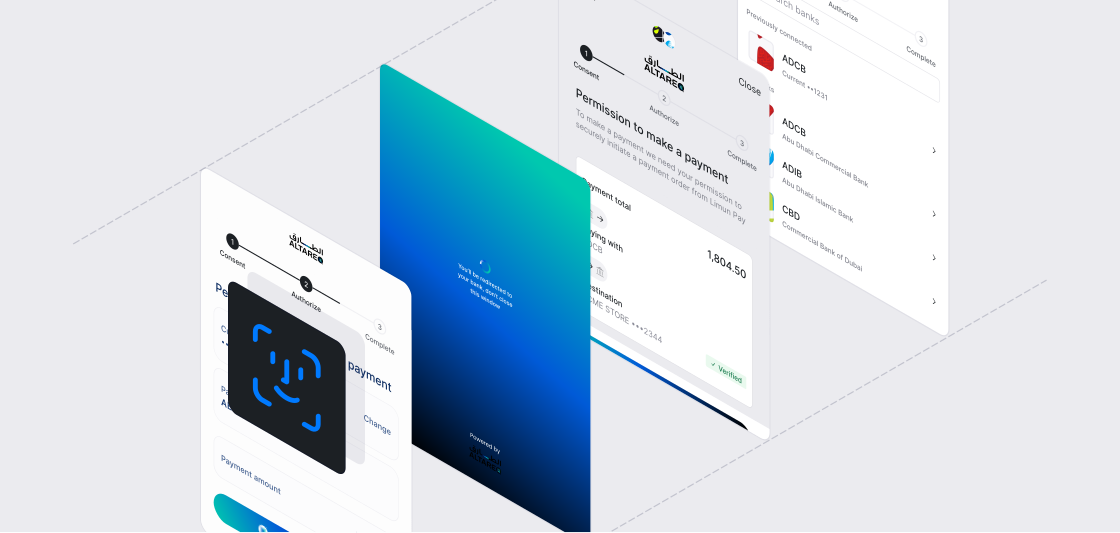
Lean Deposits closes that gap by removing card networks and manual transfers entirely. A user taps to deposit in the app, authenticates in their banking app, and funds move directly, account-to-account, from the user's bank to the business's. The business gets a confirmed outcome in real time.
There is no card network in the middle. No transfer to track down. No support ticket about a deposit "still pending after three hours."
The experience also compounds. Once a user authorizes Lean once, the bank account is saved as a payment method on file. Every subsequent top-up is a single tap, with no channel switching and no waiting.
This is what we mean when we say funding becomes part of the product, not a friction layer in front of it.
The infrastructure underneath
Speed at the funding moment is not a UX problem. It is an infrastructure problem, and Deposits is built on infrastructure that took years to put in place.
In the UAE, Lean Deposits runs on the Central Bank's Open Finance framework, uses AlTareq for payment initiation, and settles over Aani, the country's 24/7 instant payment rail. Lean is regulated by ADGM, holds in-principle approval from the UAE Central Bank, and powered the country's first live customer-initiated Pay by Bank deposit with Ziina earlier this year.
That foundation is what lets a single API move money instantly, account-to-account, with a real-time signal of success, at national scale. It is the part users never see, and the part that makes everything else feel effortless.
Where Deposits matters most
Deposits create the most value in industries where the speed of funding is the speed of the product. Three industries are leading the shift.
Trading and investing
In trading, the gap between intent and a funded account is the gap between catching a move and watching it pass. Card funding can take minutes the market does not give back. Manual bank transfers can take hours.
Capital.com closed that gap with Lean. Through Pay by Bank, deposits are confirmed as final at the moment the user authorizes them, so traders can act on the position straight away rather than waiting for funds to clear. Settlement time on those flows dropped by 100%. On standard top-ups, switching to Lean cut funding costs by 20% versus cards.
eToro, and Sarwa are running on the same model. Replace the variable cost and unpredictable timing of card-based funding with an account-to-account flow that matches the speed of the asset class. In a category where activation is measured in minutes and retention is measured in repeat trades, removing friction at the funding moment is one of the highest-leverage product changes a trading platform can make.
Wallets and super-apps
For wallets and super-apps, the funding moment is woven through every other use case. A user cannot pay, transfer, or split a bill if their balance is empty. Every minute spent topping up is a minute the wallet is competing with whatever app the user opens next.
e& money introduced Lean Pay by Bank and embedded direct bank top-ups in their app. The monthly return rate of customers doubled because repeat funding became effortless: fewer steps, fewer failed attempts, and instant confirmation meant users could top up in the moment and keep using the app, while transaction costs dropped significantly. Careem Pay made the same shift, moving from card-based funding to Pay by Bank deposits, a cost profile that finally matched the small, frequent top-ups Careem Pay users wanted to make.
Ziina took it further. As the first licensed financial institution in the UAE to go live with customer-initiated Pay by Bank deposits, built on Lean's infrastructure, Ziina users now fund directly from their bank in the app, with no channel switching and no manual transfer. BOTIM is on the same foundation. Across all of them, the bank becomes the payment method, and topping up stops feeling like a transaction.
Remittance and crypto
Remittance and crypto compress the funding moment further. A rate moves. A token moves. A recipient is waiting. In both cases, the user's job is not "fund the account." It is "send the money" or "make the trade." Funding should not be a factor in whether they catch a rate or place a trade.
LuLu Finance and Rain use Lean Deposits to make sure it isn't. Direct bank funding gives users an instant path from balance to outbound transfer or asset purchase, with no card limit, no FX surprise at the issuing bank, and no 24-hour bank transfer wait. Reconciliation is automatic on the business side, which means support teams stop fielding "where's my deposit?" tickets and start working on the questions that actually grow the product.
What changes when funding gets out of the way
Across every one of these industries, the same pattern shows up.
Time-to-first-transaction shrinks. Users who fund in seconds transact in seconds, and the product earns a place in the moments that matter, like a market move, a checkout, or a remittance window, rather than losing the user's attention to a faster app.
Repeat funding compounds. Account-on-File turns the second, fifth, and fiftieth top-up into a single tap, and that is when funding stops being a UX surface and becomes a habit. The products with the fastest deposit experience are usually the ones with the highest repeat-funding rates; the two are not separate metrics.
Cost structures get healthier. Replacing card fees with account-to-account economics means small deposits stay viable, refunds stop being expensive, and the unit economics of a frequent-use product finally make sense at any ticket size. Across Lean's customers, this shift has driven more than $100 million in card fee savings to date.
Operations get quieter. Real-time confirmation makes reconciliation instant, and "is my payment confirmed?" disappears as a support category. Finance teams reconcile from a single source of truth instead of stitching together card statements and bank deposits.
None of this is theoretical. It is what is running on Lean today, across more than 350 customers and over $4 billion in processed volume.
Funding is the product
The fastest products in MENA are not the ones with the most features. They are the ones where the gap between a user's intent and the action they wanted to take has been engineered down to nothing.
Funding is where that gap is widest, and where closing it pays back the most. Lean Deposits is how the region's leading trading platforms, wallets, and remittance apps are closing it, on infrastructure that is regulated, real-time, and built for the way money is meant to move now that Open Finance is live.
In markets that move fast, funding fast is not an edge. It is the experience.
Customers
Processed
Saved on Card Fees
Continue reading
Pay by Bank: The Next Evolution of Digital Payments in the UAE
How Tamara Expanded Credit Access by 32% for the Modern Workforce with Financial Data
Tamara is Saudi Arabia’s homegrown FinTech platform, empowering millions of customers and thousands of merchants with innovative financial solutions. Founded in Riyadh, Tamara’s mission is clear: “We help people own their dreams”. Guided by this purpose, Tamara offers simple and flexible payments solutions, designed around how people manage their finances, inspiring greater control and confidence in their daily lives.