By Youssef Montasser
Lean Collections: Automated Repayments in the UAE
For businesses that collect repayments over time, reliability directly affects cash flow, operating cost, and customer experience.
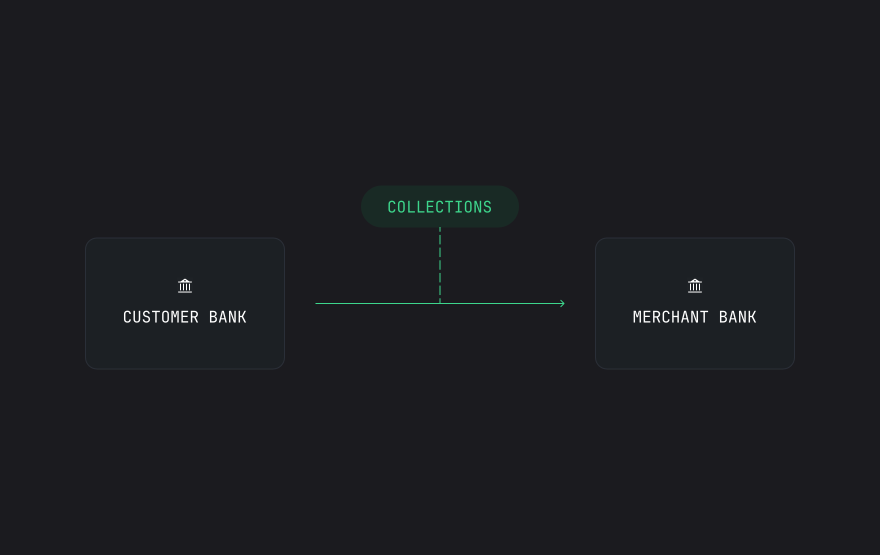
How Lean Collections helps UAE businesses collect recurring payments with less manual work
For businesses that collect repayments over time, reliability directly affects cash flow, operating cost, and customer experience.
Across the UAE, most businesses have historically relied on two collection methods: cards and manual bank transfers. Both introduce friction into the repayment experience, particularly for products built around recurring payments, high repayment volumes, and clear payment visibility.
Lean Collections was built to solve these pain points through bank-authenticated repayments powered by the Open Finance framework.
Where collections breaks today
Most repayment flows were built around cards and manual bank transfers.
That works until the business starts collecting at scale.
Cards fail for ordinary reasons. They expire. They get replaced. Limits change. 3DS challenges time out. The customer may still want to pay, but the payment does not go through. The business then has to retry, remind, follow up, and recover.
Manual transfers create a different problem. The money may arrive, but not always with the right reference. Finance has to match payments manually. Support asks customers for proof. Operations loses time confirming whether a repayment is late or just hard to identify.
These are not edge cases. They are the daily work of collections teams.
How Lean Collections works
Lean Collections uses bank-authenticated consent.
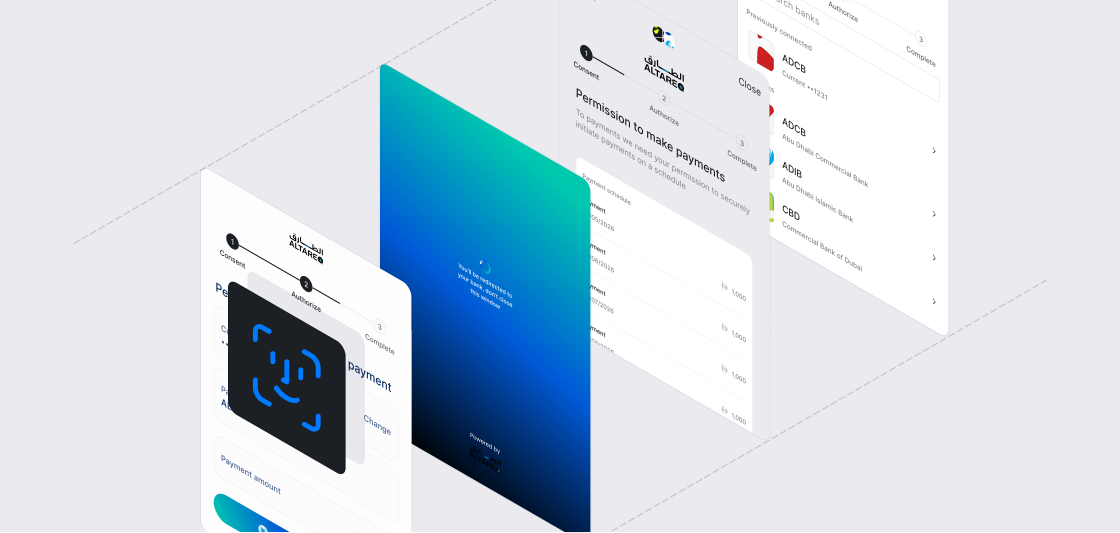
The customer gives authorization once inside their banking app. The business can then initiate agreed repayments from that bank account on the right dates, without asking the customer to re-enter card details or manually transfer each time.
Every payment has a clear status.
Confirmed.
Failed.
Pending.
Matched to the right customer.
That means support can answer questions faster. Finance can reconcile without chasing screenshots. Risk can see missed payments sooner. Operations can focus on the exceptions that actually need attention.
Lean Collections is not limited to scheduled repayments. The same bank-authenticated flow can also start offline, in person, or through a direct payment request.
A customer buying a new iPhone on BNPL, for example, can scan a QR code at the store counter, approve the payment in their banking app, and authorize the future installments from the same bank account. The first interaction happens in store, but the recurring repayments are set up at the same time.
Pay by Link works in the same way for remote collections. A team can send a payment request by WhatsApp, SMS, or email. The customer opens the link, authorizes in their bank app, and the payment is attributed to the right account.
Pay by QR supports in-person moments: a BNPL checkout at a counter, a leasing agent collecting a deposit at a viewing, a branch team collecting a catch-up payment, or a finance team closing an outstanding balance face to face.
Scheduled debits, payment links, and QR payments can work together as one collections flow. Businesses can collect now, set up future repayments, and keep every payment tied to the same customer record, status view, and reconciliation process.
Why this is possible in the UAE now
In the UAE, Lean Collections is built on the country’s Open Finance infrastructure.
It uses the Central Bank of the UAE’s Open Finance framework, AlTareq for payment initiation, and Aani for instant settlement. Strong Customer Authentication happens at the bank level, so the customer approves the payment in an environment they already trust.
Lean is licensed and regulated by ADGM, holds in-principle approval from the UAE Central Bank under the Open Finance framework, and was the partner behind the country’s first live customer-initiated Open Finance payment earlier this year.
For businesses, the value is practical: collect from a verified bank account, with consent, real-time status, and a clear record of each payment.
Where Lean Collections matters most
Lean Collections is most useful when repayments are frequent, high-value, or regulated.
Three areas stand out in the UAE.

BNPL: fewer failed installments
BNPL businesses collect a high volume of small installments.
At that scale, small failure rates become expensive. An expired card is not just one failed payment. It triggers reminders, retries, support tickets, and recovery workflows. It also affects on-time repayment rates.
Bank-authenticated repayments reduce that failure surface. The customer gives consent once, and future installments can be collected from the bank account. There is no stored card to expire, and fewer payments fail because of card-specific issues.
For BNPL platforms, that means better repayment predictability and lower cost-to-collect.
Tabby and Tamara are part of Lean’s ecosystem, and the commercial logic is clear: when every basis point matters, reducing payment failure and card-processing cost has a direct impact on unit economics.
Real Estate and RNPL: cleaner high-value payments
Rent and property payments are different.
The amounts are larger. The timing matters. And when something goes wrong, the customer, landlord, and platform all want an answer quickly.
Manual transfers make this harder than it needs to be. References are mistyped. Screenshots get shared. Finance has to match incoming funds. Support has to confirm whether the payment landed.
Lean Collections gives the customer a bank-app approval flow and gives the business a clear payment record. That helps with monthly rent, installment plans, deposits, and catch-up payments.
For A2A payments in the UAE, where larger ticket sizes and slower payment cycles make card fees and manual reconciliation more painful. Pay by Link and Pay by QR extend the same experience to moments outside the monthly schedule, such as a security deposit, first rent payment, or overdue balance.
Traditional lending: clearer records and lower operating cost
For lenders and finance companies, collections is closely tied to risk, finance, and compliance.
Auditors need to know that each debit was authorized. Risk teams need to know which repayments failed. Finance needs payments matched to the right account. The business needs to keep processing and recovery costs under control.
Manual reconciliation and ambiguous payment statuses make all of this harder.
Bank-authenticated repayments give lenders a clearer authorization record, real-time payment outcomes, and cleaner reconciliation. They also reduce reliance on cards, which can improve repayment economics without weakening controls.
For a large lending book, that is not just a better payment experience. It is a more manageable operating model.
What changes for the business
When collections move to bank-authenticated repayments, the benefits are easy to see.
Cost-to-collect drops. Fewer card fees, fewer retries, and less manual reconciliation reduce the cost of collecting each repayment. Across Lean’s customers, the shift away from card payments has driven more than $100 million in card fee savings to date.
On-time repayment improves. Some missed payments happen because customers cannot or will not pay. But many happen because the payment method fails. Removing card expiry and manual transfer issues helps more payments land when they should.
Operations gets simpler. Support stops asking for screenshots. Finance spends less time matching payments. Risk gets faster visibility into failed repayments. Teams work from the same payment status instead of separate spreadsheets, tickets, and chat threads.
Compliance gets cleaner. Each repayment is linked to bank-authenticated consent and a clear payment outcome. That gives regulated businesses a stronger record when they need to show how a payment was authorized and what happened next.
Lean is already processing more than $4 billion in volume across more than 350 customers, with collections use cases across BNPL, real estate, lending, insurance, and embedded finance.
The collection moment matters
For BNPL platforms, rent platforms, and lenders, collections is where payment operations either stay simple or become expensive.
A failed card payment, an unmatched transfer, or a repayment collected outside the normal schedule can quickly turn into support tickets, manual reconciliation, and unclear payment status.
Lean Collections brings these moments into one bank-authenticated flow. The customer authorizes through their bank app, repayments are collected from the same account, and each payment returns with a clear status.
That gives teams one way to manage scheduled repayments, one-off collections, and in-person payments, without treating each scenario as a separate operational process.
Continue reading
Pay by Bank: The Next Evolution of Digital Payments in the UAE
How Open Banking is simplifying access to credit in the BNPL space
Transforming How Schools Accept Tuition Payments: A New Era of Connectivity in the UAE
The traditional methods of accepting tuition payments, cash, cheques, or even credit cards are causing unnecessary headaches for schools in the UAE. These outdated processes are costly, time-consuming, and prone to errors, leading to cash flow issues and inefficiencies for school finance and operations teams.